Omnichannel marketing: a complete guide for brands

Omnichannel marketing is the practice of connecting every channel a customer touches, web, app, email, social, store, into one continuous, consistent experience.
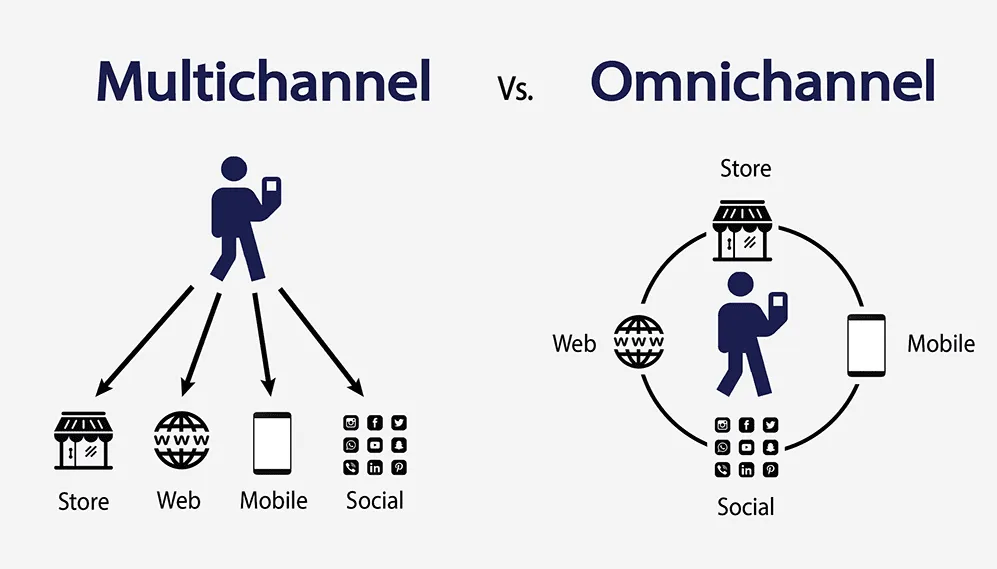
The difference from ordinary multichannel marketing is integration. Multichannel means you’re present on lots of platforms. Omnichannel means those platforms talk to each other, so the customer picks up exactly where they left off, on whatever channel they choose, without ever repeating themselves.
It matters because customers already behave this way. The average shopper crosses more than 250 touchpoints across desktop, mobile and physical stores before a purchase, and Harvard Business Review found 73% of buyers use multiple channels during a single shopping journey. Those omnichannel buyers spend more, 4% more in store, 10% more online, and they expect the brands they buy from to keep up.
Key takeaways:
- Omnichannel marketing unifies every channel into a single, frictionless customer experience.
- It differs from multichannel marketing, where each channel runs in its own silo.
- A strategy holds it together: shared data, consistent messaging, and channels that hand off cleanly.
- The hard part isn’t the tech. It’s the system: connecting data, content and distribution so every channel reinforces the others.
What is omnichannel marketing?
Omnichannel marketing is an approach that unifies all of a customer’s interactions with your brand into one continuous experience. Unlike traditional, channel-by-channel marketing, it treats the customer’s full relationship with you as a single thread, and tailors interactions, offers and rewards to where they are in that journey.
Here’s what it looks like in practice:
- A customer adds a product to their basket on your website, then leaves without buying.
- Fifteen minutes later, an automated email nudges them to complete the purchase.
- The next day, a social ad shows the same products with a 15% discount.
- They open your app and resume from exactly where they left off.
Every channel knows what the others know. The experience feels like one conversation, not four disconnected ones.
What is the difference between multichannel and omnichannel marketing?
Multichannel and omnichannel sound similar, but the distinction is the whole point.
Multichannel marketing puts you on multiple channels, social ads, email, website, store, but each one operates in a silo. The channels don’t share data or context, so the customer experience resets every time they switch.
Omnichannel marketing integrates those channels so information flows freely between them. The customer journey is continuous: what happens on social informs what happens in email, which informs what happens in store.
The other difference is scope. Multichannel might mean “we run social ads and send emails”. Omnichannel means every channel a customer could find you on is mapped into one journey, and orchestrated to move them forward.
What is an omnichannel marketing strategy?
An omnichannel marketing strategy is the plan that makes the integration work. Without one, you have a collection of channels; with one, you have a system.
A strong strategy defines your messaging and brand positioning across every channel, sets out how each channel earns its place in the journey, and specifies what data you collect at each step. It’s the difference between channels that happen to coexist and channels engineered to reinforce one another.
How it plays out depends on the sector:
Omnichannel retail marketing
Retail moves fast on both sides. Consumer expectations shift constantly, and the technology behind retail sales evolves with them. Customers now discover and buy through in-store visits, websites, apps, live shopping, augmented reality and social commerce. Omnichannel retail marketing folds all of it into one coherent experience, so the brand feels the same wherever the customer meets it.
Omnichannel pharma marketing
Pharmaceutical brands often market to two very different audiences at once: healthcare professionals and individual patients. Each needs different messaging, which makes segmentation essential. A consumer might move between their GP, a hospital, a pharmacy and other services before a purchase, so the strategy has to connect those touchpoints and deliver the right message at the right moment.

How do you build an omnichannel marketing strategy?
91% of brands say they have or plan to build an omnichannel strategy, yet only 8% feel they’ve mastered it. That gap makes sense: the channels customers use keep evolving, and connecting them is genuinely hard work that usually reaches well beyond the marketing team.
The framework below is a starting point: four moves that take you from scattered channels to a connected system.
1. Start with your data
What do you already know about your customers? When are they most likely to buy, which time of day, which day of the week? Are there differences in age, gender or lifestyle across your customer groups that should shape how you talk to each one?
This is the foundation. Everything downstream, messaging, targeting, sequencing, is only as good as the data underneath it.
2. Connect the right tools
Because omnichannel spans every channel a customer touches, those channels need to share information in real time. That means an integrated stack: a fast, mobile-friendly website, a frictionless checkout, and systems that pass data cleanly between applications rather than trapping it in silos. The goal isn’t more tools. It’s tools that connect.
3. Get the whole team on board
Conversion isn’t a marketing-only job. As you integrate messaging, channels and technology, bring sales, customer service and other relevant teams in early. Set up a cross-functional group with real representation from across the business, and make the benefit concrete for each team: better leads for sales, richer customer data for service, fewer surprises for operations.
4. Measure and iterate
Capture data on everything: how content performs, which subject lines land, where the UX breaks. Which channels under-deliver? Does conversion change with send time? Does an SMS bring customers back to an abandoned basket, or get ignored? The more honestly you read the data, the sharper your next decision, and the better your brand investment over time.
How do you launch your first omnichannel campaigns?
When you start out, resist the urge to do everything at once. If your audience lives mostly on Instagram and TikTok, don’t dilute your effort across every platform on day one.
Focus on consistent content and genuine engagement on your core channels, then add more once you’ve seen what works. Pay attention to how your brand fits each channel: LinkedIn, Instagram and X all differ in post length, hashtag norms and how people expect you to engage. Email is different again in length and tone.
Adjust your content and calls to action to each context rather than copy-pasting across them, and keep your channels connected, so you always have a single, joined-up view of how your marketing is performing.

Omnichannel marketing examples
These brands have built integration into the core of how they sell.
Amazon
Amazon set the standard for frictionless customer experience. Customers can browse and buy across the website, the mobile app and Alexa, and the experience carries between them. Browse an item on the app without buying, and you’ll likely be prompted to continue when you return on web. Layer on personalised recommendations and targeted ads built from past behaviour, and you get a journey that feels custom-built for each shopper. That continuity is a big part of how Amazon became the giant it is.
Sephora
Sephora has fused mobile and in-store about as tightly as any beauty retailer. Walk into a physical store and the app surfaces a store map and current deals. Customers build a Beauty Bag, part wishlist, part purchase history, and use a ‘Reserve Online, Pickup In Store’ option that bridges digital and physical into one experience.
Oasis
Fashion retailer Oasis connected its website and app so customers move seamlessly between the two. Its paid membership tier, Oasis Unlimited, offers unlimited next-day delivery, great value for the customer, and a rich source of first-party data the brand uses to personalise future offers.
You’ll find more brands worth learning from in our case studies.
How we see it: omnichannel is a system, not a stack
The instinct is to treat omnichannel as a software problem: buy the platform, connect the channels, done. The harder, more valuable problem is the system: deciding which signals matter, how channels hand off to one another, and how each touchpoint compounds the next.
Influence sits inside that system, not beside it. Creator content is one of the few assets that travels across every channel at once. It earns attention on social, fuels paid distribution, lends credibility on your product pages, and gives email and CRM something worth sending. Treated as a one-off post, it’s a campaign. Connected into the journey, it becomes infrastructure: a distribution layer that makes every other channel work harder.
That’s the difference between brands that are merely present everywhere and brands whose presence actually compounds.
Standing out in a crowded market
In a saturated market, personalisation and relevance are how you build a real relationship with customers, and both have come a long way. As buying behaviour keeps shifting, the brands that win are the ones that respond to expectations in real time, across every channel.
If you’re early in this, a few pointers worth holding onto:
- Start small. Break your strategy into modules tied to each channel, then find the common thread that connects them.
- Lead with your primary channels. Prove the model where your customers already are, then expand as you learn.
- Connect technology deliberately. Bring in the stakeholders who hold critical context, supply chain, fulfilment, service, because those realities shape the experience too.
- Test and learn. Not every tactic will work. Make small bets, read the data, and iterate fast.
‘Show me you know me’ is what customers are really asking for. Omnichannel done well is how you answer.
FAQs
What is the difference between omnichannel and multichannel marketing?
Multichannel marketing means being present on several channels that each operate independently. Omnichannel marketing connects those channels so data and context flow between them, giving the customer one continuous experience regardless of where they engage.
What are the key KPIs for omnichannel marketing?
The metrics that matter most are customer engagement rate, conversion rate, customer retention rate, average order value and overall return on investment. Tracked across channels rather than in isolation, they show whether your integration is actually moving customers forward, and where the journey is breaking.
How do smaller brands implement omnichannel marketing?
Start with the channels you already use well, social, email, your website, and focus on consistency and shared data across them before adding more. You don’t need an enterprise stack to deliver a connected experience; you need your existing channels to stop working in silos.
Building the system behind the channels
Mapping your channels is the easy part. Connecting them into a system where every touchpoint compounds the next, and where creator-led content becomes the distribution layer that powers the whole journey, is the harder, more valuable work.
That’s the work we do. Vamp is a tech-enabled influencer marketing agency: we design creator-led growth systems and build the infrastructure to run them, so influence performs across every channel instead of sitting in one. Talk to us.