What is influencer marketing? A complete guide for brands

Influencer marketing is the practice of partnering with creators who hold attention and trust within a community, so a brand reaches its audience through someone that audience already chooses to listen to.
That’s the textbook answer. The more useful one is this: influencer marketing has stopped being a tactic you bolt on and started becoming infrastructure you build. The brands getting real value aren’t running a string of one-off posts. They’re designing creator-led systems that generate content, distribution, credibility and performance from the same investment.
This guide covers what influencer marketing is, who creators are, how it works, what it costs, and how to do it well, without the hype.
The short version:
- Influencer marketing reaches audiences through creators they already trust, not interruptive ads they ignore.
- Influence is no longer judged on follower count. Relevance, resonance and performance decide who’s worth working with.
- It works when it’s built as a system, strategy, creators, content and distribution connected, not as a series of disconnected campaigns.
- Cost scales with ambition and structure, not with a fixed price list.
Why influencer marketing matters now
Content went from media-led to creator-led, and audience attention moved with it. People trust people. A recommendation from a creator a community already follows lands differently to a banner ad, because it arrives inside a relationship the audience opted into.
A few signals that make the scale hard to ignore:
- The global influencer marketing market reached a record 24 billion U.S. dollars in 2024 and has kept climbing.
- More than five billion people now use social media, well over half the planet.
- The creator economy has scaled into the hundreds of millions of creators worldwide, turning a niche into an industry.
- Authenticity consistently out-performs polish, which is why smaller, sharply relevant creators often beat the biggest names on outcomes.
The takeaway isn’t “everyone is on social, so post more”. It’s that influence is now where trust is built and decisions are shaped, and that makes it something to engineer deliberately, not something to dabble in.
What is an influencer?
An influencer is a person, or group, who has built an audience around a topic, niche or way of life, and whose recommendations genuinely move that audience’s opinions and decisions.
The appeal is specificity. Influencers tend to anchor on a platform and a subject, speaking to their followers in a voice that’s unmistakably theirs. That trust is the asset. It’s also why follower count is a weak proxy for value: a creator with 30,000 deeply engaged followers in a defined niche can out-perform a generalist with millions.
What is a creator?
A creator overlaps heavily with an influencer, but the centre of gravity is different. Creators make things because they’re driven to make things. The craft comes first, the influence follows.
Most are closely involved in every part of the work and in constant conversation with the people who follow it. The distinction matters for brands because it shapes the partnership: creators bring production capability and a built-in audience, which is why we treat them less as media placements and more as ecosystems of attention, community and cultural relevance.

How does influencer marketing work?
At its simplest, influencer marketing works by partnering with creators who reach your audience, then collaborating on content that earns attention and drives action. You decide who you work with, on which platforms, and toward which outcomes.
But the gap between “ran some posts” and “drove measurable growth” is enormous, and it comes down to how the work is structured. A single post is a moment of visibility. A connected programme of creators, content and distribution is a system that compounds:
- The right creators put you in front of audiences who already trust the source.
- The right content gives you assets you can use far beyond the original post, across paid, owned and earned channels.
- The right distribution turns a one-off spike into sustained, measurable presence.
This is how we see it at Vamp: influence isn’t something you run, it’s something you engineer. The brands that win aren’t choosing creators one campaign at a time. They’re building an operating model where every activation feeds the next.

How much does influencer marketing cost?
There’s no single price, because influencer marketing isn’t a product with a tariff. Cost is shaped by the type and number of creators, the platforms, the volume and quality of content, the duration, and, most of all, whether you’re buying isolated posts or building a system.
A few honest anchors:
- Nano and micro creators are the most cost-efficient entry point and often the strongest on engagement and authenticity.
- Macro and celebrity creators command far more, and you’re paying for reach, which is only worth it when reach is genuinely the objective.
- Production, usage rights and paid amplification are real line items. Content you can re-use across channels is where a lot of the hidden value sits.
The more useful question than “what does it cost?” is “what is it worth?”. A series of disconnected posts is hard to measure and easy to waste. A creator-led system, where content, distribution and performance are designed together, is where the spend starts compounding into something you can actually track back to growth.
What are the different types of influencer?
Influencers are usually grouped by audience size. Bigger isn’t better; it’s just different, and the right tier depends entirely on your objective.
| Type | Typical following | Best for |
|---|---|---|
| Nano | ~1,000–10,000 | Hyper-relevant niches, high trust, strong engagement |
| Micro | ~10,000–100,000 | Loyal communities, efficient cost-per-result |
| Macro | ~100,000–1M | Broad reach with some community depth |
| Mega / celebrity | 1M+ | Mass awareness, cultural moments, premium spend |
The instinct to chase the biggest names is the most common and most expensive mistake. Smaller creators frequently deliver better outcomes per pound, because relevance and trust convert where raw reach doesn’t.
Who is the biggest influencer in the world?
By follower count, Cristiano Ronaldo sits at the top of the global rankings, with a combined following across platforms in the hundreds of millions. The graphic below maps the most-followed accounts on social media.
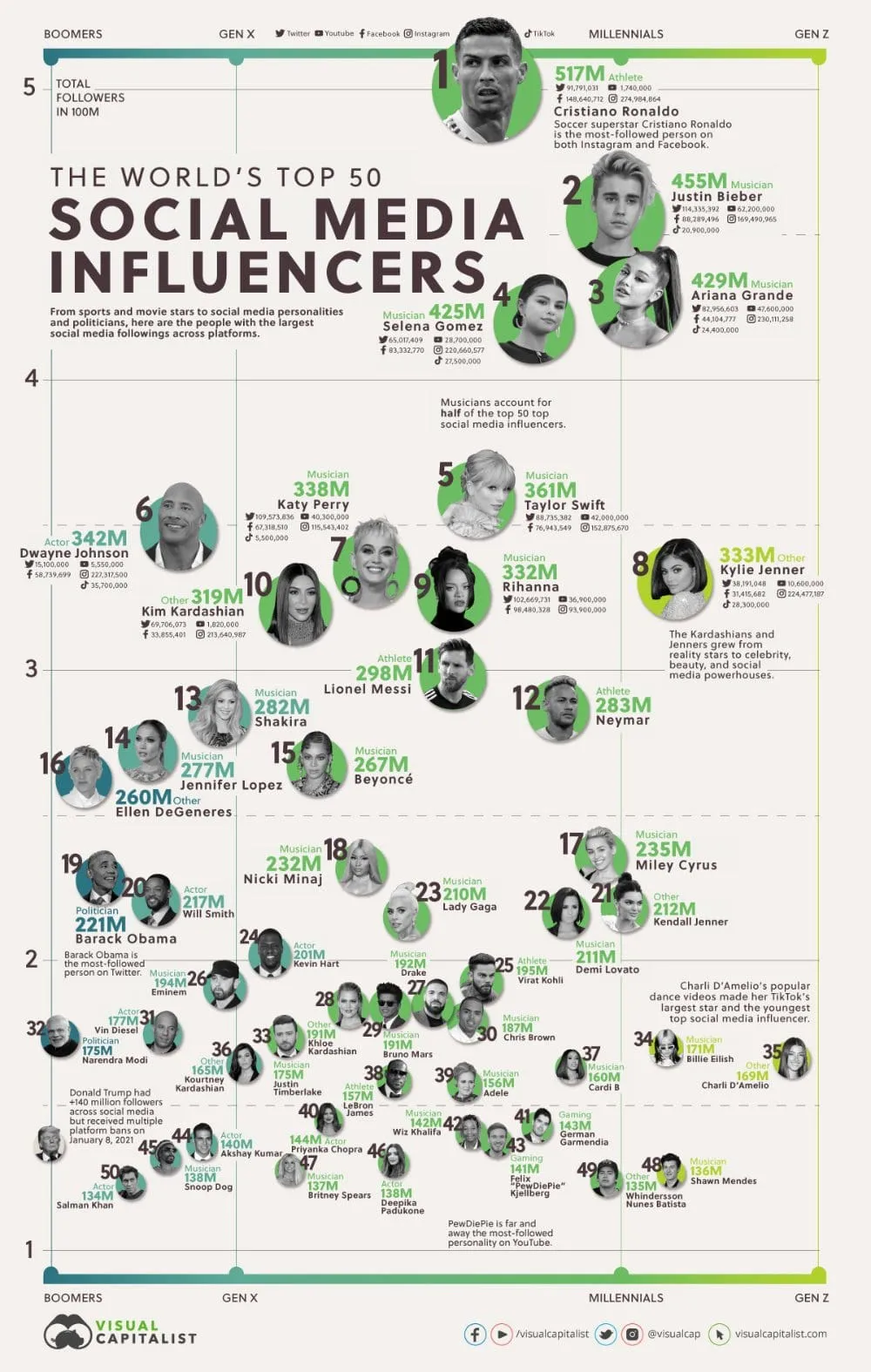
Worth noting: the most-followed account is rarely the right partner for a brand. Audience size tells you almost nothing about relevance to your audience or your ability to drive a result.
Which social media platforms are best for influencer marketing?
The strongest platforms for creator-led marketing today are TikTok, Instagram, YouTube and, increasingly, LinkedIn for B2B, alongside podcasts and long-form video. But “best” is the wrong frame. The right platform is wherever your audience pays attention and your creators do their best work.
What matters more than platform choice is coherence across platforms. Most brands run each channel in isolation and wonder why the results don’t add up. Treating creators, content and distribution as one connected system, rather than a set of separate campaigns on separate apps, is what turns scattered activity into measurable growth.
How to build an influencer marketing strategy: six steps
A good strategy is a system, not a checklist. These six steps are the structure underneath one:
- Define the outcome, not the activity. Decide what growth actually looks like, new customers, share of voice, social commerce, brand consideration, before you choose a single creator. The objective sets everything downstream.
- Understand the audience properly. Who they are, what they value, and crucially, which creators they already trust. The audience leads you to the creators, not the other way round.
- Match creators to intent, not to follower count. Shortlist for relevance, values alignment and the kind of content they make, not the size of the number next to their name.
- Build real partnerships. Brief creators on the outcome and trust them on the execution. They know their audience better than you do; the best work comes from collaboration, not control.
- Design content for re-use. Plan how each asset lives beyond its original post, across paid, owned and earned, so one investment works in multiple places.
- Set KPIs you can defend. Agree realistic, measurable goals up front, and put the tracking in place to judge against them. If you can’t measure it, you can’t improve it.
Here’s an influencer marketing strategy template to get you started.
Frequently asked questions
What’s the difference between influencer marketing and creator marketing?
They’re often used interchangeably. The practical distinction: influencer-led work leans on a person’s reach and recommendation, while creator-led work also leverages their production skill to make content a brand can use across channels. The strongest programmes do both.
Does influencer marketing actually work?
When it’s structured well, yes, because it reaches audiences through trusted sources rather than interruptive ads. It fails when it’s treated as a one-off post with no clear objective, no measurement, and no connection to the rest of a brand’s marketing.
How do I measure influencer marketing?
Tie it to outcomes you care about, sales, leads, share of voice, consideration, not just likes and reach. The reason disconnected campaigns are hard to measure is that they’re not built to be; a system designed around performance is.
Should brands work with an agency or do it in-house?
In-house works for simple, low-volume activity. As soon as you’re operating across multiple creators, platforms and markets, the coordination, measurement and content systems are where it gets hard, and where a specialist partner earns its place.
Influencer marketing is not a campaign. It’s infrastructure.
Knowing what influencer marketing is and how it works is the easy part. Turning it into sustained, measurable growth is the harder, more valuable problem, and it’s the one we solve.
Vamp is a tech-enabled influencer marketing agency. We don’t run one-off campaigns; we design creator-led growth systems that connect strategy, creators, content and distribution into one operating model, so influence performs instead of just appearing. If you’re ready to build it properly, talk to us.