User-generated content: a brand's guide to UGC that performs

User-generated content (UGC) is any content, photos, videos, reviews, posts, created by customers and creators rather than the brand itself, and used to earn trust the brand can't manufacture alone.
It works because it’s believable. People trust other people more than they trust advertising, so content made by real users carries credibility that polished brand assets can’t buy. Studies suggest UGC earns up to 50% more attention than branded content and can lift web conversions by around 29%.
But authenticity at scale isn’t an accident. The brands that win with UGC don’t just hope it appears. They build a system that consistently generates it, sources the rights to use it, and routes it to where it converts. This guide covers what UGC is, why it works, and how to organise it into something that performs.
The short version:
- UGC is content created by customers, fans and creators, not the brand.
- It works because it reads as authentic, which is the one quality brands can’t fake.
- The benefit isn’t free content; it’s social proof that moves purchase decisions.
- Treated as a one-off, UGC is a lucky win. Treated as a system, it compounds.
What is user-generated content (UGC)?
User-generated content is any content, text, images, video, reviews, testimonials, created and shared by customers and individuals rather than the brand itself. It’s a core ingredient of social and content marketing because it’s authentic and relatable in a way brand-made content rarely manages.
It comes from several sources: customers, brand loyalists, employees, and UGC creators, people paid by brands to produce content that looks and feels organic, even when it’s commissioned.
What’s the difference between UGC and influencer-generated content (IGC)?
UGC and influencer-generated content (IGC) are both effective, and they’re easy to confuse, but they do different jobs.
UGC is content made by customers, employees and fans who want to talk about a product, usually without payment. Its power is perceived authenticity: when people see others using and loving a product, it builds trust and makes them more likely to buy.
IGC is content made by creators a brand pays to produce and post. Creators bring an engaged audience and craft, which gives brands a way to reach a ready-to-buy community with intent and consistency that spontaneous UGC can’t guarantee.
The two aren’t rivals. They’re layers. UGC supplies credibility; IGC supplies reach, control and reliability. The brands that get the most out of either are the ones that connect them, so genuine customer enthusiasm and commissioned creator content feed the same engine rather than running on separate tracks.
What are the main types of user-generated content?
UGC is flexible in who makes it and in the type of content they make. The common formats:
- Images, photos of people using or enjoying products, helping prospects picture themselves doing the same.
- Unboxing videos, a closer, more informative look at a product as it’s opened and tried.
- Product review videos, first-hand thoughts and experiences with a product.
- Live streams, real-time video that lets creators answer questions in the moment.
- Social posts, reviews, testimonials and Q&A woven into everyday content.
- Hashtags, a way to build momentum and let brands track content shared about them.
- Reviews and testimonials, ratings left on a brand’s site or third-party platforms like Yelp, Google and Trustpilot.
- Blog posts, reviews and tutorials from bloggers that brands can link to.
- Q&A forums, public threads where people share opinions on products and brands.
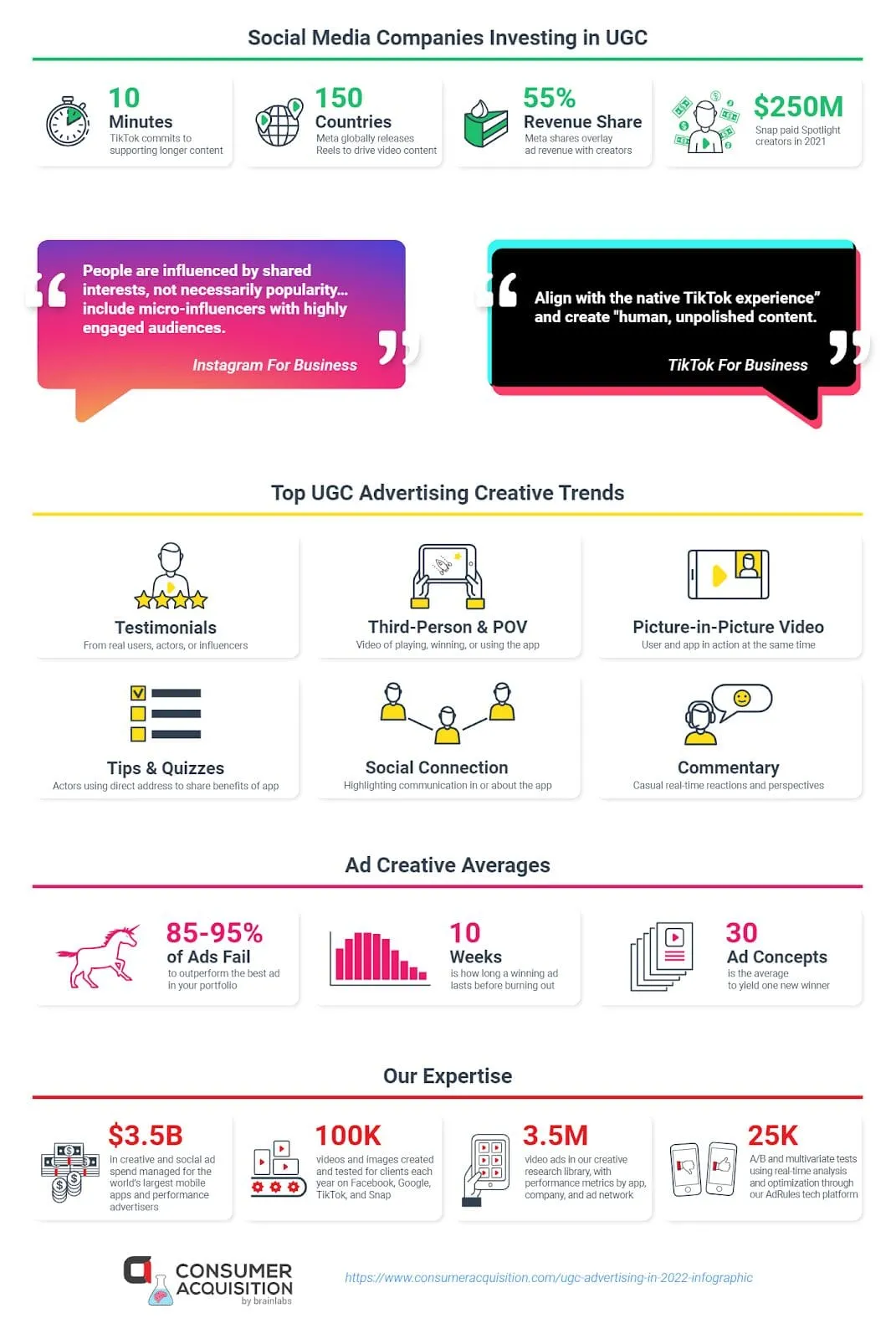
What do the statistics say about UGC?
We’re firm believers in UGC because we see what influencer-led UGC does for brand growth first-hand. But the data backs it up. A few numbers worth knowing:
- 92% of consumers trust referrals from people they know.
- 90% of consumers say authenticity matters when deciding which brands to support.
- Brand engagement rises by 28% when professional content and UGC are shown together.
- UGC-based ads earn 4x higher click-through rates.
- 70% of consumers will consider UGC reviews or ratings before buying.
Read together, these say one thing: trust is the conversion lever, and UGC is how brands earn it at scale.
What are the benefits of user-generated content?
The case for UGC comes down to what it earns a brand:
Authenticity, it shows real experiences and real opinions, building trust with prospects who’ve learnt to tune out advertising.
Brand loyalty and community, inviting customers to create content gives them a stake, which deepens loyalty and builds an engaged community around the brand.
Trust signal, consumers trust content made by fellow customers more than content made by brands, which makes UGC a credibility multiplier.
Influence on purchase decisions, UGC is social proof, showing real people choosing your product at the exact moment a prospect is deciding.
Cost efficiency, it draws on content customers already want to make, which makes it efficient relative to fully produced campaigns.
Flexibility, it works across social, email, landing pages and ads, so one asset can be reused across the funnel.
SEO value, reviews and customer content generate fresh, keyword-rich pages and backlinks, supporting organic search visibility (organise it with intent and the benefit compounds).
Engaged community, UGC opens a genuine two-way exchange between brand and customer, which is harder to fake and more valuable than reach alone.
How do you integrate UGC into your marketing strategy?
UGC pays off when it’s built into a strategy, not bolted on. The essentials:
- Set clear goals. Define what UGC is for, awareness, conversion, community, and align the rest of the plan to it. The objective decides what “good” content looks like.
- Request permission and give credit. Always secure usage rights before reposting, and credit the original creator. Rights management is where most UGC programmes quietly fall over, so make it a step, not an afterthought.
- Be specific. Give clear guidance on the content you want. Vague briefs produce off-brand content; precise ones produce assets you can actually use.
- Use the right tools. Platforms like TINT, Hootsuite Streams and others help you surface, organise and rights-manage UGC at volume.
How we see it: most brands treat UGC as a feed to monitor. The brands that get compounding returns treat it as a system to design: clear briefs, sourced rights, and a repeatable path from content created to content converting.
How do you encourage customers to create UGC?
Great UGC rarely appears on its own. Brands have to make it worth creating. A few proven approaches:
- Offer incentives, coupons, reward points or prizes for reviews, photos and videos.
- Run hashtag contests, a memorable, ownable hashtag that gives people a reason and a place to post.
- Gamify it, badges or points for sharing a photo or writing a review turn participation into a habit.
- Showcase the best of it, featuring real customers using your products signals that contributions get seen, which encourages more.
How does UGC perform on TikTok?
UGC dominates TikTok, where it can outperform polished ads by around 22%. The platform rewards content that looks native to the feed, and UGC is native by definition, a narrow case of why relevance beats production value across creator content generally.
Build a trusted network of UGC creators on TikTok and the content doesn’t have to stay there. Strong assets can be repurposed for YouTube, Reels, Pinterest and Facebook, so one source feeds multiple channels.
For more on the platform, see our breakdown of the TikTok algorithm and how to make UGC work natively in the feed.
Which brands do UGC well?
The brands that nail UGC don’t just collect it. They design moments worth posting about. Some standout examples:
GoPro sustains its YouTube channel largely on customer footage, with user-shot videos regularly pulling millions of views.
Lululemon invited followers to share photos under #thesweatlife, turning everyday workouts into a steady stream of brand reach.
Coca-Cola’s Share a Coke put names on bottles and asked people to post their personalised drinks. Free samples seeded it; the #ShareaCoke hashtag did the rest. Coca-Cola credited the campaign with a 2% lift in US sales.
Belkin x Lego invited customers to build iPhone cases out of Lego and share them on Instagram under #LEGOxBelkin.
Copa90 used UGC on social during the 2018 FIFA World Cup to connect with younger fans and drive traffic across its channels.
What links them: each gave people a clear, low-friction reason to create, and a system to capture what came back.
How do influencers strengthen a UGC strategy?
Influencers are the difference between hoping UGC appears and engineering a reliable supply of it. Spontaneous customer content is valuable but unpredictable; creators bring intent, craft and a built-in audience.
Collaborate with the right creators and they do three things at once: produce authentic-feeling content on brief, reach audiences who’d never have found you organically, and lend credibility that makes the rest of your UGC more believable. Connect the two layers, organic customer content and commissioned creator content, and you have a system that produces social proof on demand rather than by luck.
For more, see our guide to TikTok influencer marketing.
FAQs
What’s the difference between UGC and influencer content?
UGC is made by customers and fans, usually unpaid, and reads as spontaneous and authentic. Influencer-generated content is commissioned from creators with an audience, giving brands reach, craft and reliability. Used together, UGC supplies credibility and influencers supply scale.
Do brands need permission to use UGC?
Yes. Always secure usage rights before reposting customer or creator content, and credit the original maker. Rights management is the step most UGC programmes neglect, and the one most likely to cause problems if skipped.
Is UGC cheaper than influencer marketing?
Per asset, often. It draws on content customers already want to make. But “cheap” is the wrong lens. The real value is the trust UGC carries and the conversions that trust drives, which is why the strongest programmes invest in sourcing, rights and distribution rather than just collecting whatever appears.
UGC isn’t content you collect. It’s a system you build.
A single great customer video is a nice surprise. A steady supply of authentic content that’s sourced, rights-cleared and routed to where it converts. That’s an asset. The gap between the two is design.
That’s the work we do. Vamp is a tech-enabled influencer marketing agency: we build the creator and content systems that turn authentic, on-brand UGC into measurable growth, not a folder of posts nobody uses. Talk to us.