How the TikTok algorithm works in 2026
The TikTok algorithm is a recommendation system that decides which videos appear on each user's For You page, based on how they behave, not how many followers a creator has.
It watches what you watch. Every TikTok algorithm decision comes down to signals: the videos you finish, replay, like, share and search for, weighed against details in the content itself. Get those signals right and a video reaches the exact people likely to enjoy it. Followers help, but they don’t decide the outcome. A brand-new account and a household name start the same race.
This guide covers what the TikTok algorithm is, the ranking signals that actually move distribution, what it ignores, and how brands and creators earn reach that compounds rather than spikes.
Key takeaways:
- The TikTok algorithm ranks content by user behaviour: watch time, completion, replays, shares and searches matter more than follower count.
- Three signal groups drive it: user interactions, video information, and device/account settings.
- Watch-through rate is the strongest single signal. If people finish your video, TikTok shows it to more people.
- Search is now central. TikTok behaves like a search engine, so captions, on-screen text and keywords decide whether your content is discoverable months later.
- Distribution that lasts comes from a system, consistent posting, a clear niche and content built for completion, not from chasing a single trend.
What is the TikTok algorithm?
The TikTok algorithm is the recommendation system behind the For You page (FYP), the endless, personalised feed users see the moment they open the app. No two For You pages are identical, because each one is built from an individual’s behaviour: what they watch, finish, skip and search.
Even a brand-new user gets a tailored feed. With no history to draw on, TikTok seeds early recommendations from broad interest signals and the behaviour of similar users, then narrows fast as you interact. Within a session, it’s learning.
Here’s how TikTok itself describes the For You feed:
“A stream of videos curated to your interests, making it easy to find content and creators you love, powered by a recommendation system that delivers content to each user that is likely to be of interest to that particular user.”
What signals does the TikTok algorithm use to rank videos?
Every platform runs its own formula for keeping people scrolling. TikTok’s draws on three groups of signals:
- User interactions
- Video information
- Device and account settings
The system reads everything it can across those three groups, then curates the For You page accordingly. Below is what sits inside each.
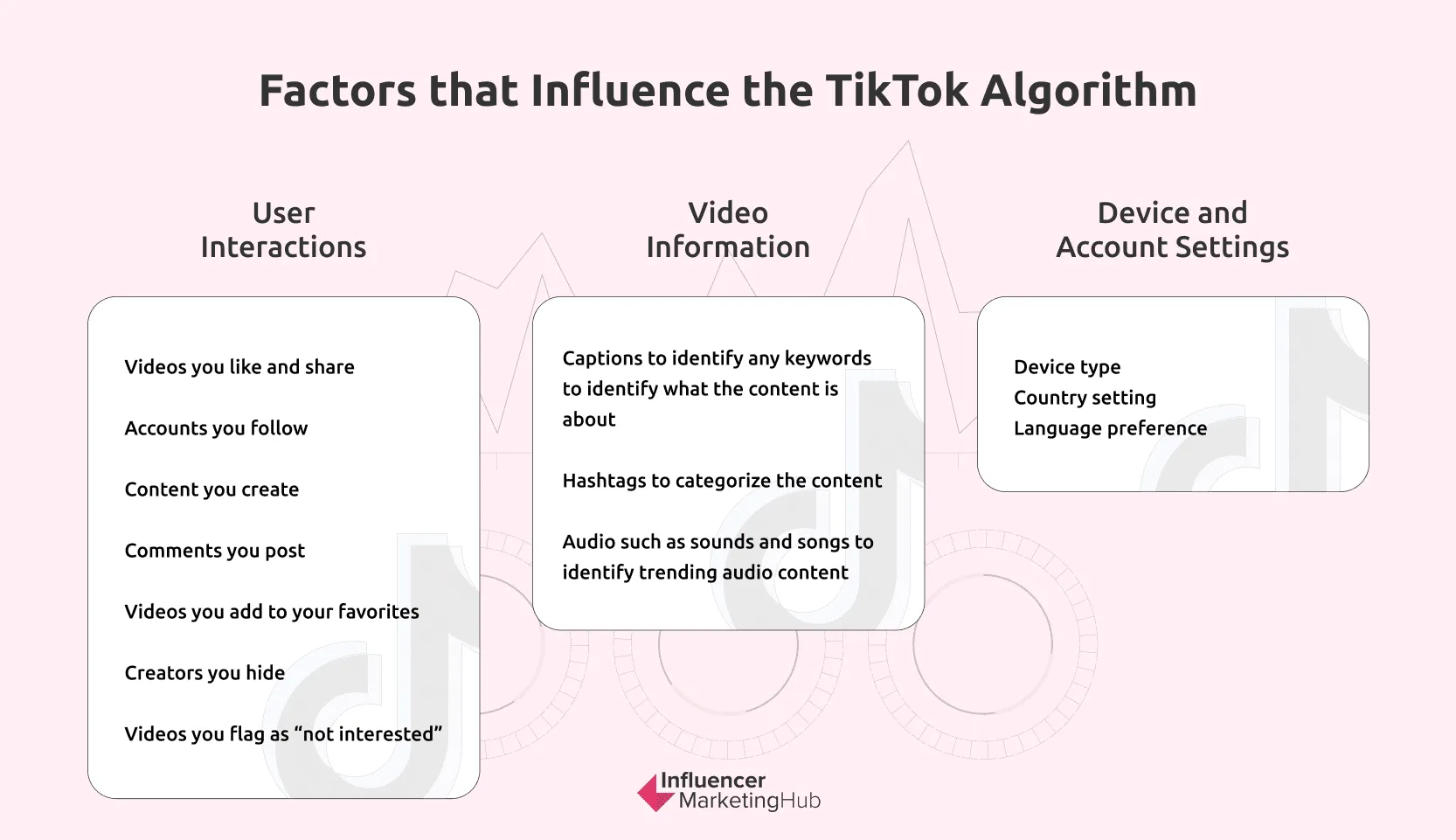 Source: Influencer Marketing Hub
User interactions
This is the heaviest-weighted group. The algorithm reads the actions that reveal what someone genuinely wants more of:
- How long you watch a video, and whether you finish it
- Videos you replay or rewatch
- Videos you like, share or save to favourites
- Comments you make
- Accounts you follow
- Content you hide or mark ‘not interested’
- Videos you report as inappropriate
- The creators and topics you search for
- Your own content and the interests it reflects
One signal towers over the rest: watch-through rate. A video that holds attention to the end, or gets replayed, tells TikTok the content is worth pushing. It’s the closest thing the platform has to a single growth lever.
Video information
These are the signals carried by the content itself, the details TikTok reads to understand what a video is about and who should see it:
- Captions and on-screen text
- Sounds and music
- Hashtags
- Effects
- Trending topics and keywords
This group is where discoverability is won or lost. (More on the search dimension below. It has become one of the biggest shifts on the platform.) If you want to understand how hashtags fit into a wider distribution play, see our breakdown of a TikTok hashtag challenge vs. a branded hashtag challenge.
Device and account settings
These carry less weight, they’re optimisation signals, not engagement ones, but they still shape what surfaces:
- Language preference
- Country setting
- Type of mobile device
- Interest categories selected when you joined
What does the TikTok algorithm ignore?
Some things genuinely don’t move the needle. TikTok confirms the algorithm does not recommend:
- Duplicated content
- Content you’ve already seen
- Spam
- Content flagged as upsetting or unsafe
And the part that levels the field: TikTok doesn’t weight recommendations by follower count or by a creator’s past hits. A strong video from a small account can reach the same For You pages as one from a platform giant. Distribution is earned per video, on the merits of that video, which is exactly why a systemised approach beats a lucky break.
How do you get your videos seen on TikTok?
Reaching the right For You pages isn’t luck. It’s a set of repeatable decisions that stack the signals in your favour:
- Use a TikTok Business or Pro account. You get analytics on views, follower growth and per-video performance, the data you need to learn what works and do more of it.
- Pick a clear niche. Decide the lane you’re known for, then study the videos already performing well in it. Consistency of topic helps the algorithm understand who to show you to.
- Build for completion. Quality matters, but the real target is watch-through. Strong hooks in the first second, tight pacing and a reason to stay to the end do more for distribution than production polish alone.
- Reply to your audience. Answer comments, and use video replies to turn common questions into more content.
- Post in series. A run of videos on one theme, each revealing something new, gives people a reason to come back, and gives the algorithm repeated signals to read.
The first rule still holds: great content comes first. If you’re unsure what good looks like in your space, study the accounts already winning it.
Influencer Marketing Hub points to e.l.f. Cosmetics as a brand doing this well, sharing tips, tutorials, reviews and consistently watchable content rather than one-off ads.
@elfyeah Get with the e.l.f.ing program besties 🥰💖
Beyond the fundamentals, four levers consistently improve a video’s chances.
Use trending sounds early
TikTok’s licensed sound library lets you use music without copyright worries. Sounds that are climbing, not ones that have already peaked, give the algorithm a freshness signal to ride. Timing is everything: catch a sound on the way up.
Caption everything and write for search
Captions help the large share of viewers who watch on mute, and they make your content accessible to people who are hard of hearing. They also do something bigger: they make your video readable to TikTok’s search. Search Engine Land quotes creator Kate Smoothy: “We’re seeing a huge shift with the platform where videos optimised for their search feature seem to perform better.”
Write descriptions and on-screen text around the specific keywords your audience actually searches. We go deeper on this in our guide to TikTok SEO for marketers.
Collaborate with the right creators
Appearing in each other’s videos, through duets, tags or shared challenges, extends both audiences. The detail that matters: collaborate with creators whose audience size and values align with yours, so the exchange is balanced and the relevance holds.
Join trending challenges and hashtags
Search the trending hashtags and find a creative, on-brand way into the topics people are already engaged with. Relevance beats reach here. A trend you can genuinely contribute to outperforms one you’re forcing.
Post consistently
You don’t need to post daily. But a dormant account gives the algorithm nothing to read. Keep a steady cadence, and repurpose your TikTok videos across your other channels to compound the reach.
@later.com TikTok now shows you why a particular video was recommended to you in your FYP! ✨ #tiktoknews #socialmedianews #tiktokfeature #fypexplained #greenscreen ♬ original sound – Later
How do you reset your TikTok For You page?
You can’t dictate what the algorithm does with your content, but you can retrain your own feed. To reset what TikTok shows you:
- Tap the three dots in the top-right corner of the app
- Select Free up space, then clear the cache
- On your For You page, press and hold any video you don’t want more of and select Not interested
Once TikTok registers what you’re skipping, it recalibrates and shifts the feed towards what you do engage with. The same logic applies to your content: the algorithm learns from behaviour, so behaviour is the thing to design around.
How does TikTok search work?
TikTok increasingly behaves like a search engine, and that changes how brands should think about content. The Discover surface and the search bar let users explore by keyword, hashtag, sound and creator, and search results increasingly drive discovery, not just the For You feed.
To search, tap the search icon at the top right and enter a precise query. The most relevant results appear under the Top tab, with Users, Videos, Sounds, LIVE and Hashtags tabs for more targeted exploration. For brands, the takeaway is direct: content optimised for the terms people search stays discoverable long after it’s posted, a stark contrast to feed content that lives and dies in a day.
How do you promote content on TikTok?
Beyond organic growth, the Promote feature turns one of your videos into an ad and reports back on:
- Views
- Likes, comments and shares
- Website link clicks
- The demographics of people interacting with your video
You’ll find Promote inside Creator Tools or TikTok Business Suite, or by opening an existing video, tapping More and selecting Promote. Used well, paid amplification extends a video that’s already earning organic signals. It works best as fuel for content the algorithm already likes, not a fix for content it doesn’t.
Common TikTok algorithm myths
Search Engine Land clears up the most persistent misconceptions:
- “You must post daily.” TikTok says daily posting isn’t required for growth. Experimenting to find what resonates matters more than raw frequency.
- “Creator Fund members get favoured.” Being in a monetisation programme doesn’t earn algorithmic preference. Those accounts tend to perform because they’ve learned how to make content people finish, not because of a payout. (Here’s how the TikTok Creator Fund actually works.)
- “TikTok is only for short videos.” It started with seven-second clips, but you can now post long-form video running to 10 minutes, and upload longer content too. Format follows the story, not a stopwatch.
FAQs
What is the most important TikTok ranking factor?
Watch-through rate. A video that holds attention to the end, or gets replayed, is the strongest signal you can send. Follower count, by contrast, doesn’t directly influence recommendations.
Does follower count affect the TikTok algorithm?
No. TikTok doesn’t weight recommendations by how many followers an account has or by its past performance. Every video earns its distribution on its own merits, which is why small accounts regularly outreach large ones.
How long does it take to grow on TikTok?
There’s no fixed timeline, because distribution is earned per video. Accounts that grow fastest tend to share a clear niche, a consistent cadence and content built for completion, a system, not a single viral moment.
Is TikTok search worth optimising for?
Increasingly, yes. As TikTok behaves more like a search engine, keyword-optimised captions and on-screen text keep content discoverable for months, not just the day it’s posted.
Knowing the algorithm is table stakes. Building distribution that compounds is the real work.
Understanding how the TikTok algorithm works gets you to the start line. The harder, more valuable problem is turning that knowledge into reach that compounds: a clear niche, a steady cadence, creators chosen for relevance, and content engineered for completion rather than luck.
That’s the work we do. Vamp is a tech-enabled influencer marketing agency: we design creator-led growth systems and build the distribution behind them, so attention on TikTok becomes measurable growth instead of a single spike. We’re an official TikTok creative marketing partner, and we partner with brands building always-on influence rather than one-off campaigns. Talk to us.