How to use hashtags on Instagram: the dos and don'ts

To use hashtags on Instagram well, pair a few specific, relevant tags with your content rather than stuffing in popular ones. Relevance, not volume, is what gets you discovered.
Hashtags group your post into a searchable pool of content carrying the same tag, so people who don’t follow you can still find you. Used with discipline, they extend reach, sharpen who sees your work, and feed Instagram’s algorithm clearer signals about what your post is actually about. Used lazily, they do nothing, or quietly throttle your reach.
There’s been a lot of contradictory advice doing the rounds, much of it written for an Instagram that no longer exists. Here’s how hashtags work now, and the dos and don’ts that still hold up.
The short version:
- Hashtags categorise your content so non-followers can discover it via search and the Explore page.
- Relevance beats volume. A few precise, on-topic tags outperform a wall of generic ones.
- Mix high-traffic and niche tags so you compete in big conversations and win small ones.
- Irrelevant or repeated hashtags can get your content demoted. Instagram treats them as spam.

How do people discover your content through hashtags?
When someone taps a hashtag, it opens that tag’s page. The page splits into two views: ‘Top’ and ‘Recent’.
‘Top’ surfaces the highest-performing posts for that tag, content that has earned the most likes, comments and saves, which is why the algorithm pushes it to the front. Those posts can be hours or days old. ‘Recent’ shows the newest posts in chronological order.
You want to land on ‘Top’, because that’s where the sustained visibility is. And the way you get there is engagement: strong early signals earn more reach, which earns more engagement. On Instagram, momentum compounds.
How to use hashtags on Instagram: the dos and don’ts
Do take Instagram’s suggestions
As you start typing a tag, Instagram suggests similar hashtags that are active on the platform. They’re often close variations you wouldn’t have thought of, and the right variation can open a more relevant audience. You can also type a keyword into the Explore page and tap the ‘Tags’ tab; Instagram will suggest options and show how many posts already use each one, so you can gauge how crowded the field is.
Don’t only use popular hashtags
The biggest tags are the most competitive. A hashtag with tens of millions of posts drops your content into an enormous pool where it’s buried by newer posts within minutes. A tighter, more specific version of the same tag has a fraction of the volume, and a far better chance of standing out and staying visible.
Take footwear: a broad tag like #Shoes is saturated, while a narrower one like #ShoesOfInstagram is far smaller and more targeted. Mix the two registers. The popular tags buy you exposure in high-traffic conversations; the niche ones buy you staying power with audiences who actually care.
Do consider creating your own hashtag
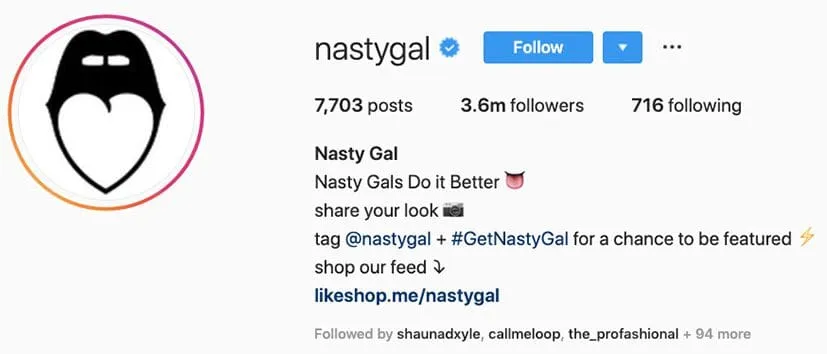
A branded hashtag gives you somewhere to collect everything in one stream: campaign content, creator posts, and user-generated content all tagged together. Done well, it becomes a living, searchable library of brand assets on Instagram and a channel for incoming UGC.
This is also where a tag earns its keep over time. A branded hashtag that your community actually uses turns scattered posts into a compounding archive of social proof, the kind of distribution asset that keeps working long after a single post fades.
Don’t use irrelevant hashtags
Tagging a post with hashtags that don’t match the content hurts you. Instagram lets users hide content from any tag with a ‘Don’t show for this hashtag’ option, and enough of those signals will get your post demoted by the algorithm. Even short of that, hashtags-for-the-sake-of-it is wasted effort. The goal is to reach a specific, engaged audience, not to spam an indifferent one.
Do include them in Stories
You can add a hashtag sticker to a Story just as you would to a feed post. The difference: Instagram only adds your Story to a public tag grouping if the algorithm judges it strong on quality and engagement. It isn’t automatic, but when it lands, it can reach a wide audience, and it adds continuity to a campaign running across both feed and Stories.
Don’t use symbols
Symbols like % or $ break a hashtag. Stick to letters and numbers.
Do try emoji hashtags
Emoji hashtags work, they’re eye-catching, and they keep your captions tighter. Used sparingly, they’re a small edge.
Don’t keep repeating the same hashtags
Pasting an identical block of tags onto every post is a tell that you haven’t tailored them to that specific piece of content, and Instagram’s community guidelines flag “posting repetitive comments or content” as a violation. Build each set around the post in front of you, not a saved template.
Do use your insights to measure what works
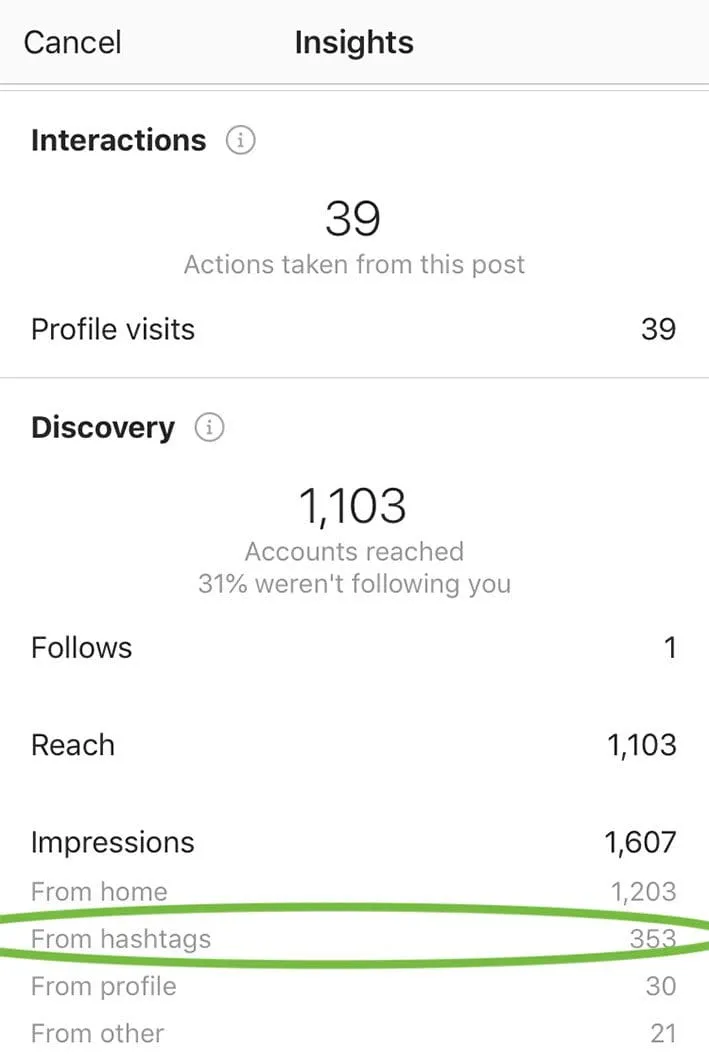
A professional (business or creator) account gives every post a ‘View insights’ panel that shows how many people found the post through hashtags. Treat it as a feedback loop: check which tags are actually driving discovery, drop the ones that aren’t, and refine your set over time. Hashtags are a system you tune, not a list you set and forget.
Don’t feel like you always have to play by the rules
Discovery is the main job of a hashtag, but it isn’t the only one. Plenty of creators use hashtags as a punchline, an aside, or a way to extend a caption’s story. These tend to lead to a near-empty tag page if anyone taps them, but done with wit, they add personality and can earn engagement in their own right. Know the rules well enough to break them on purpose.
FAQs
How many hashtags should you use on Instagram?
Quality matters more than hitting a number. A focused set of relevant, varied tags, a mix of broader and niche, consistently outperforms a maxed-out wall of generic ones. Start tight, watch your insights, and adjust.
Where should you put hashtags, in the caption or the first comment?
Either works for discovery; Instagram reads both. Many brands and creators move tags to the first comment to keep the caption clean. Pick whichever keeps your post readable, and stay consistent so you can compare results.
Do hashtags still matter on Instagram?
Yes, but as one discovery signal among several. Instagram increasingly surfaces content through search, keywords and the Explore page, so relevant hashtags work best alongside clear captions and on-topic content rather than as a standalone reach hack.
Hashtags get you found. A system makes you matter.
Learning the dos and don’ts of Instagram hashtags is table stakes. The harder, more valuable problem is turning scattered discovery into sustained, measurable relevance, the kind that compounds across every creator, post and platform working for your brand.
That’s the work we do. Vamp is a tech-enabled influencer marketing agency: we design creator-led growth systems and build the distribution behind them, so attention becomes measurable growth rather than a lucky hit. Talk to us.